
What is data analysis?
It is a systematic process of examining, cleaning, transforming, and modelling raw data to extract useful information, identify patterns, draw conclusions, and support informed decision-making for business growth, performance improvement, and problem-solving. It involves converting complex, large datasets into clear, actionable insights, often presented through visualisations such as charts and graphs, to understand trends, predict outcomes, and optimise strategies. It is the process of systematically applying statistical and/or logical techniques to describe, depict, summarise, and evaluate data.

Four main types of data analysis-
- Described – It focuses on summarising the data to show past performance. Results are typically presented through visualisations and summary tables.
- Predictive– Use past and historical data to forecast trends. It requires clean and relevant historical data to train the models.
- Diagnostic – Involves techniques such as drilling down, data mining, and correlation analysis to identify anomalies and dependencies.
- Perscipted– The most sophisticated and complex form of analysis, building upon insights from all three previous types and uses techniques like optimisation, simulation, and business rules.
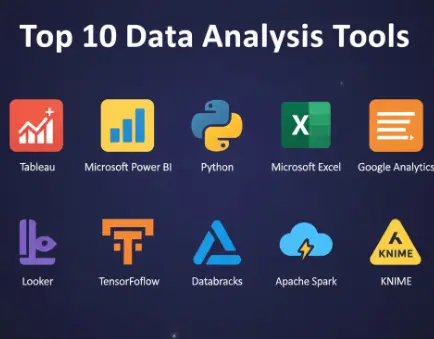
What are Data Analysis tools?
- Tablaue- It leads data visualisation and business analysis, like graphs, charts, and maps.
- Microsoft Excel- Empowers you to understand your data through natural language queries that allow you to ask questions about your data without having to write complicated formulas.
- SQL– Structured query language for data analysis refers to the database querying language’s ability to interact with multiple databases at once, as well as its use of relational databases.
- Python– It is a widely used, flexible programming language with many libraries. These are important for analytics and intricate calculations.
- Power BI– Power BI refers to Power Business Intelligence and is a Microsoft suite of tools and services designed for analysing data and sharing interactive visualisations. Power BI transforms raw data from various sources into actionable insights through dashboards and reports, making it an essential tool for data analysis-driven decision-making.
- Google Analytics- It is a powerful, free platform that tracks and reports website and app traffic. It provides valuable insights into user behaviour, the performance of marketing campaigns, and conversion goals. This tool helps businesses understand who visits their site, how users interact with content, where visitors come from, and what actions they take.

Why data analysis is important-
- It transforms raw data into actionable insights that drive informed, evidence-based decisions, improve efficiency, better understand customers, identify opportunities, and mitigate risks in business, research, and other fields for competitive advantage and strategic growth. It shifts organisations from relying on guesswork to understanding patterns, trends, and performance, thereby driving innovation and better outcomes.
- Perhaps the most crucial function of data analysis and reporting is empowering better decision-making at all organisational levels. Companies that use analytics are five times more likely to make quicker decisions, giving them a significant competitive edge in rapidly changing markets.
- Data analytics is the practice of using analytical tools to derive insights from datasets to inform decisions. With data analytics, organisations can improve decision-making, streamline operations, and increase revenue.
What skills do you need to be a data analyst?
- Technical skills– A data analyst needs technical skills like SQL, Essential for querying, manipulating, and defining data in relational databases. This is arguably the most critical technical skill.
- Python or R– Used for advanced statistical analysis, machine learning model building, data cleaning, and visualisation. Python is highly versatile, while R is often preferred in academic or specialised statistical environments. Spreadsheets Proficiency in advanced functions for quick analysis and reporting.
- Soft Skills- municationStorytelling with Data: The capacity to structure findings into a compelling narrative that motivates action.
- Non-Technical Translation– Explaining complex statistical concepts and methodologies in simple terms to business executives and team members, and working effectively with data engineers, business stakeholders, and domain experts.
- Data analysis Skills– Defining the Question: The ability to translate a vague business problem into a concrete, measurable analytical question.
- Root Cause Analysis- Skill in identifying underlying drivers rather than just treating symptoms in the data. Data Interpretation: Not just reporting numbers, but understanding what the numbers mean in a business context.Pattern Recognition: The ability to spot trends, anomalies, and correlations within large datasets.
What are the future trends in 2026?
- The future of data analysis is evolving rapidly, with new technologies making data more available and actionable. Artificial intelligence and machine learning are at the forefront of these changes, helping businesses analyse large quantities of data faster and more accurately. These technologies can uncover patterns and make predictions, even without deep technical expertise. It simplifies the data analysis process and produces insights and recommendations with ease.
- As data collection increases, there will be a stronger focus on data privacy and ethical standards to protect personal information. Real-time data analysis will become more pervasive, allowing businesses to make immediate, informed decisions.
- AI agents will go beyond chatbots and act as a “portor,” automatically taking actions on data, such as querying databases, creating visualisations, and improving data models.
- Data processing is moving closer to the source to enable quicker decisions, reducing the dependency on centralised ”cloud servers” for every action.
For more stuff, visit mkgrowdigi